Alaska Northern Lights Guide 2026 — Best Time, Best Spots & How to See the Aurora
Back to Blog

Alaska Northern Lights Guide 2026 — Best Time, Best Spots & How to See the Aurora

Last Frontier Events

Alaska is one of the best places on Earth to see the northern lights. The state's high latitude, dark winters, and wide-open landscapes give you front-row seats to one of nature's most spectacular shows. But seeing the aurora borealis isn't as simple as flying north and looking up. Timing, location, weather, and preparation all matter — and getting any of them wrong can mean a cold, disappointing night staring at clouds.

This guide covers everything you need to plan an aurora trip to Alaska in 2026, from the best months and locations to photography settings and what to wear when it's forty below.

Best Time to See the Northern Lights in Alaska

Aurora season in Alaska runs from roughly September through March. You need dark skies, and Alaska's summer midnight sun wipes out any chance of seeing the aurora from late April through August. The sky simply never gets dark enough.

The peak viewing window is December through February, when Alaska gets 18 to 20 hours of darkness per day in the interior. September and early October are also excellent — you get long, dark nights without the extreme cold of midwinter, and the fall equinox tends to produce heightened geomagnetic activity.

A note on the solar cycle: the sun operates on an approximately 11-year cycle of activity. Solar Cycle 25 reached its maximum in 2024-2025, and while activity is beginning to taper, 2026 is still expected to produce strong aurora displays. Elevated solar activity means more frequent and more vivid northern lights, so the 2026 season should be above average compared to solar minimum years.

The best displays often happen between 10 PM and 2 AM, though aurora can appear anytime after dark. NOAA's Space Weather Prediction Center issues short-term forecasts that can help you plan which nights to stay up.

Best Locations in Alaska for Northern Lights

Fairbanks — The Aurora Capital

Fairbanks is the best city in North America for northern lights viewing. Sitting at 64.8° north latitude, it's directly under the auroral oval — the ring-shaped zone around the magnetic north pole where aurora activity is most frequent. The University of Alaska Fairbanks Geophysical Institute estimates that the aurora is visible from Fairbanks an average of 240 nights per year.

Fairbanks also benefits from a relatively dry interior climate. While coastal Alaska is frequently overcast, the interior gets more clear nights during winter. The city has good infrastructure for aurora chasers: hotels, rental cars, restaurants that stay open late, and multiple tour operators running nightly trips.

Chena Hot Springs

Located about 60 miles northeast of Fairbanks, Chena Hot Springs Resort is one of Alaska's most popular aurora destinations. The appeal is obvious — you can soak in natural hot springs while watching the northern lights overhead. The resort sits in a valley away from Fairbanks' light pollution, and they've built an aurora viewing area specifically for guests.

The resort offers wake-up calls when the aurora appears, so you don't have to stay up all night waiting. Book well in advance for peak season; this place fills up months ahead.

Cleary Summit

About 20 miles north of Fairbanks on the Steese Highway, Cleary Summit (elevation 2,233 feet) is a favorite spot for locals and photographers. The elevated position gives you unobstructed views of the northern horizon, and you're far enough from city lights to get truly dark skies. There's a pullout area at the summit, but no facilities — bring everything you need, including a full tank of gas. Do not turn your car off in extreme cold unless you're certain it will restart.

Murphy Dome

Another Fairbanks-area favorite, Murphy Dome is about 20 miles west of the city via Murphy Dome Road. At 2,930 feet, it offers 360-degree views and minimal light pollution. The road can be icy and is not always well-maintained in winter, so a vehicle with four-wheel drive and good tires is essential. Like Cleary Summit, there are no facilities here.

Anchorage — Possible but Less Reliable

Anchorage sits at 61.2° north, which is south enough that aurora displays are less frequent and less intense than in Fairbanks. You can see the northern lights from Anchorage, but you'll typically see them low on the northern horizon rather than overhead. Strong geomagnetic storms (Kp 5 and above) can produce good shows even this far south.

If you're based in Anchorage, drive north on the Parks Highway toward Talkeetna or the Denali area to improve your chances. Getting 100 miles north of Anchorage makes a noticeable difference.

Denali Area

The Denali Borough, including the areas around Healy and Cantwell, offers dark skies and dramatic mountain backdrops for aurora photography. The Parks Highway between Fairbanks and Anchorage passes through this area, and there are pullouts with good northern views. In winter, most Denali National Park facilities are closed, but the park road is plowed to Mile 3, and the surrounding communities have lodging options.

How the Aurora Works

The northern lights begin at the sun. During solar storms, the sun ejects billions of tons of charged particles — electrons and protons — into space. This stream of particles, called the solar wind, travels roughly 93 million miles to reach Earth in one to three days.

Earth's magnetic field deflects most of this solar wind, but near the poles, the field lines funnel particles down into the upper atmosphere. When those charged particles collide with oxygen and nitrogen molecules 60 to 200 miles above the surface, the molecules release energy as light. Oxygen produces green and red light. Nitrogen produces blue and purple. The specific colors depend on altitude and the energy of the collision.

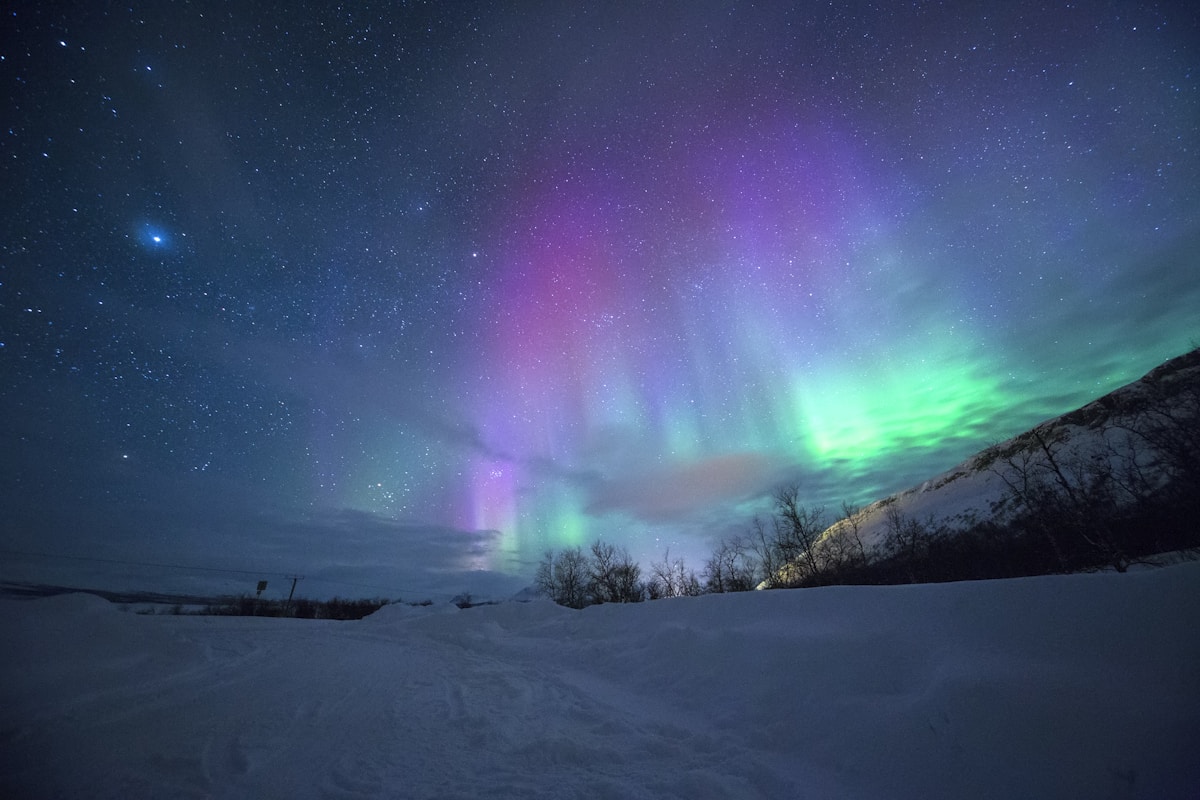
The result is the aurora — sheets, arcs, and curtains of light that shimmer and dance across the sky. The display can last minutes or hours, and it can range from a faint green glow on the horizon to an explosion of color that fills the entire sky overhead.

Photography Tips

Photographing the northern lights is straightforward once you know the settings. You don't need professional gear, but you do need a few essentials.

Gear

  • Tripod — Non-negotiable. You're shooting long exposures, and any camera movement will blur the image.
  • Wide-angle lens — A 14mm to 24mm lens lets you capture sweeping aurora displays. Faster lenses (f/2.8 or wider) are ideal.
  • Spare batteries — Cold weather drains batteries fast. Keep spares in an inside pocket close to your body.
  • Remote shutter release or timer — Touching the camera during exposure causes shake.

Camera Settings

  • Mode: Manual (M)
  • Focus: Manual focus set to infinity. Use live view to focus on a bright star, then tape the focus ring so it doesn't shift.
  • Aperture: As wide as your lens allows (f/2.8 or lower)
  • ISO: Start at 1600 and adjust. Go higher (3200-6400) for faint aurora, lower (800-1600) for bright displays.
  • Shutter speed: 8 to 15 seconds for most conditions. Longer exposures capture more light but can blur fast-moving aurora. If the curtains are dancing quickly, try 4 to 6 seconds.
  • White balance: Set to around 3500K for natural color, or shoot RAW and adjust later.

Modern smartphones — especially the iPhone 15 Pro and newer, and recent Samsung Galaxy models — can capture surprisingly good aurora photos using their night mode. Just prop the phone on something stable or use a phone tripod mount.

Tour Operators

If you don't want to drive dark, icy roads at 1 AM, aurora tour operators are a solid option. Most are based in Fairbanks and run nightly tours during the season.

  • Chena Hot Springs Resort — Offers aurora viewing packages that include hot springs access, lodging, and transportation from Fairbanks. Their ice museum and geothermal energy tours fill the daytime hours.
  • Alaska Aurora Adventures — Small-group tours that drive to the best viewing locations based on current conditions. They provide warm gear and hot drinks.
  • Gondwana Ecotours — Multi-day aurora packages that combine northern lights viewing with dog mushing, ice fishing, and cultural experiences.
  • Borealis Basecamp — Located outside Fairbanks, they offer heated glass-ceiling igloos where you can watch the aurora from bed. Popular and books up fast.

Most tours run from September through March and cost between $100 and $200 per person for a single-night outing. Multi-day packages with lodging range from $500 to $2,000+.

What to Wear

This is not optional reading. Interior Alaska in winter is brutally cold. Temperatures of -20°F to -40°F are normal in Fairbanks from December through February. You will be standing outside, mostly motionless, for hours. Dress wrong and your night ends early.

Layering System

  • Base layer: Merino wool or synthetic long underwear (top and bottom). No cotton — it holds moisture and will make you colder.
  • Mid layer: Fleece or down jacket and insulated pants.
  • Outer layer: Windproof and insulated parka rated to -40°F. Ski pants or insulated overalls.
  • Feet: Vapor barrier socks or thick wool socks inside insulated boots rated to -40°F or colder. Bunny boots (military surplus) are popular and effective. Your feet will get cold first.
  • Hands: Thin liner gloves inside heavy insulated mittens. Mittens are warmer than gloves because your fingers share heat.
  • Head and face: Balaclava or neck gaiter plus a warm hat that covers your ears. Exposed skin gets frostbitten in minutes at -40°F.
  • Hand and toe warmers: The disposable chemical warmers you can buy at any outdoor store. Stuff them in your gloves and boots. Bring extra.

If you're joining a guided tour, most operators provide extreme cold weather gear. Ask when you book.

Apps and Forecasts

Knowing when the aurora is likely to appear makes a huge difference. These tools help you plan.

  • NOAA Space Weather Prediction Center (swpc.noaa.gov) — The authoritative source. Their 30-minute aurora forecast shows the current auroral oval and predicted activity. Bookmark this.
  • Kp Index — The standard measure of geomagnetic activity on a 0-9 scale. Kp 3+ usually means visible aurora in Fairbanks. Kp 5+ means strong displays that may be visible as far south as Anchorage. Kp 7+ is a major storm visible across much of the northern US.
  • My Aurora Forecast app — Available for iOS and Android. Sends push notifications when Kp reaches your set threshold. Set it to Kp 4 if you're in Fairbanks.
  • UAF Geophysical Institute Aurora Forecast (gi.alaska.edu) — Alaska-specific forecast from the University of Alaska Fairbanks. Includes a nightly prediction and an explanation of conditions.
  • Clear Sky Chart (cleardarksky.com) — Cloud cover forecasts for specific locations. Aurora doesn't matter if it's overcast.

Common Mistakes

Expecting a Hollywood show every night. The aurora is not always green curtains filling the sky. Many nights produce a faint green glow on the horizon that's more visible to a camera than to the naked eye. Spectacular overhead displays happen, but they're not guaranteed. Plan to stay multiple nights to improve your odds.

Ignoring light pollution. Even Fairbanks has enough city light to wash out faint aurora. Get at least 15 to 20 miles from the city center. This is why spots like Cleary Summit and Murphy Dome are popular — distance from town.

Visiting in the wrong month. June, July, and August are pointless for aurora viewing in Alaska. The sun barely sets. Don't plan an aurora trip around a summer vacation.

Not checking the weather. Overcast skies block the aurora completely. Check cloud cover forecasts before driving an hour into the wilderness. If it's cloudy everywhere, save your energy for the next night.

Underestimating the cold. People from the Lower 48 genuinely do not understand -40°F. Your phone will die. Your camera battery will drain in 20 minutes. Your eyelashes will freeze together. This is not an exaggeration. Prepare accordingly.

Combining Aurora with Other Winter Activities

An aurora trip doesn't have to be all about the lights. Alaska's winter offers plenty to do during the daytime hours while you're waiting for dark.

  • Hot springs — Chena Hot Springs is the obvious choice, but there are also hot springs near Manley Hot Springs and Circle Hot Springs (currently closed for renovation — check before planning).
  • Dog mushing — Multiple operators in the Fairbanks area offer sled dog tours ranging from a one-hour ride to multi-day expeditions. This is a quintessential Alaska winter experience.
  • Ice fishing — Lakes near Fairbanks offer ice fishing for arctic grayling, pike, and burbot. Guided trips are available if you don't have your own gear.
  • Chena River ice sculpting — The World Ice Art Championships are held in Fairbanks each February and March, featuring massive ice sculptures from artists around the world.
  • Cross-country skiing and snowshoeing — Fairbanks has an extensive trail system that's groomed throughout winter.

For more Alaska winter events and festivals, visit Last Frontier Events — we track events across the state year-round.

Planning Your Trip

A solid aurora trip to Alaska looks something like this:

  • When: Plan 3 to 5 nights in the February to March window for the best combination of dark skies and (relatively) moderate cold. September is a great alternative if you want to avoid extreme temperatures.
  • Where: Fly into Fairbanks. Rent a car if you want to chase clear skies. Book at Chena Hot Springs or a Fairbanks hotel with good blackout curtains (you'll sleep during the day).
  • Budget: Flights from the Lower 48 to Fairbanks typically run $400 to $800 round trip. Hotels average $150 to $250 per night. Budget $100 to $200 per person for tours and activities. Cold weather gear rental is available if you don't want to buy.
  • Book early: Popular spots like Chena Hot Springs and Borealis Basecamp sell out months in advance for peak season.

The northern lights are one of those experiences that photos and videos cannot fully capture. Standing under a sky that's rippling with green and purple light, in silence, in the middle of the Alaska wilderness — it stays with you. Plan it right, dress warm, and give yourself enough nights. The aurora will show up.

Browse upcoming Alaska events at lastfrontierevents.com to round out your trip with festivals, concerts, and local culture.